
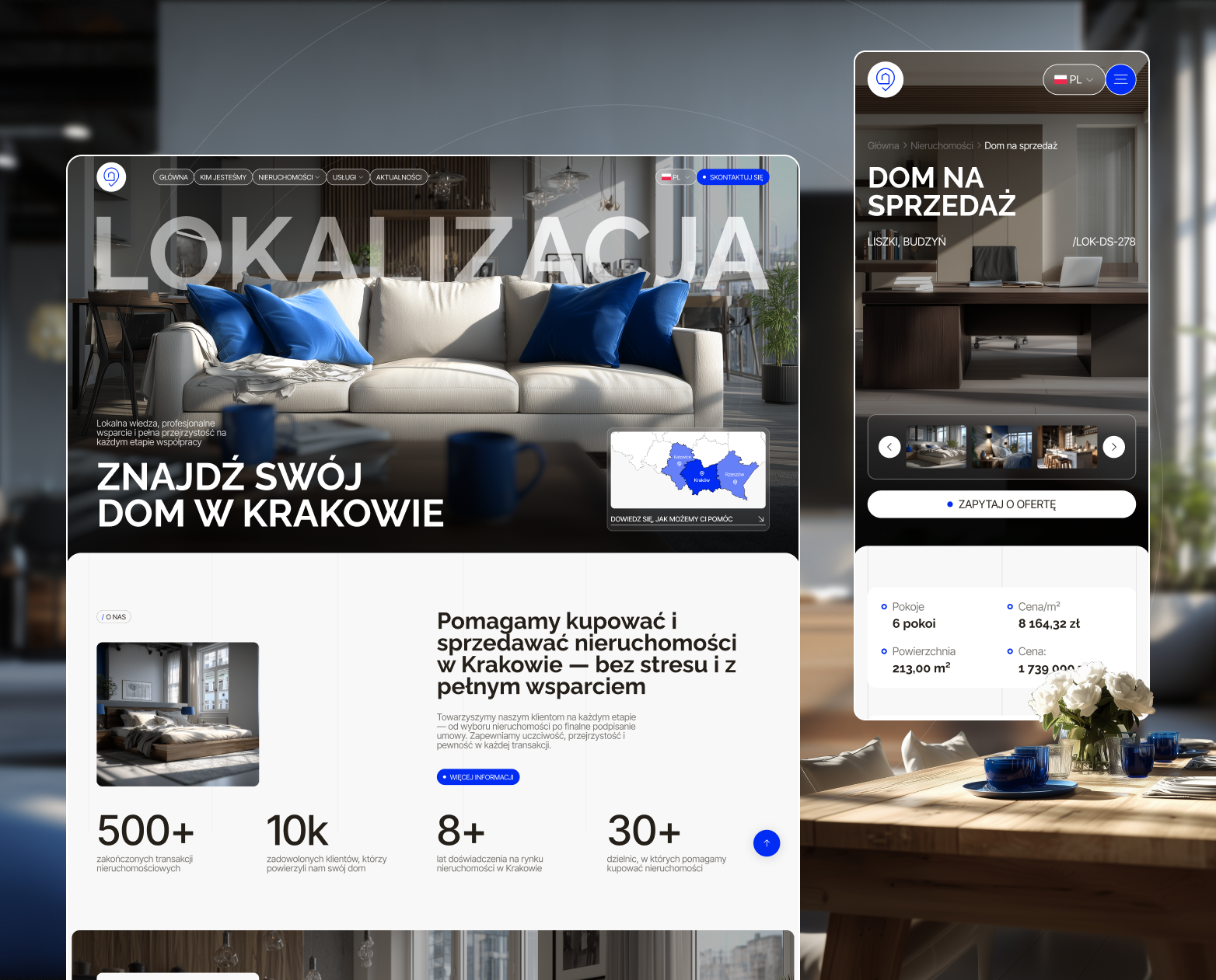
A property agency has to present both the company and its offers
Lokalizacja is a real-estate agency based in Kraków. Its website needs to introduce the agency while helping visitors explore individual properties. Those two tasks share a page but require different kinds of information: the business needs a recognisable identity, and each property needs clear photographs, a price and useful details.
Our work combines branding with a custom WordPress website in Polish and English. The public catalogue is connected to the agency's CRM, which supplies property information. Visitors can narrow the offers through filters and make an inquiry about a selected property.
The project is useful for a business owner considering a catalogue website. It shows how the public presentation, the maintained records and the inquiry route can belong to one connected experience. The site introduces the agency, but it also helps the customer do something specific with its offers.
The identity gives the agency its own presence
Property photography changes from listing to listing. Rooms, buildings and surroundings each introduce their own colours and visual character. The agency's identity therefore has a different job from the imagery: it provides a consistent presence around an evolving collection of offers.
Lokalizacja's branding accompanies the website and its listing presentation. The logo, colour and type choices give the company a recognisable visual system while the catalogue keeps the properties themselves prominent. That relationship matters when a visitor moves between several listings and returns to the agency's wider offer.
For another catalogue business, this raises a useful design question. Which elements should belong to the company, and which should be allowed to vary with the item? A coherent identity helps establish that distinction without requiring every product or property photograph to look alike.
Filters turn a broad search into a manageable selection
The catalogue includes filters for property type, sale or rent, market, location, price, price per area, area and rooms. These controls reflect different parts of a property decision. A visitor may know the location first, have a clear budget or need a particular size and number of rooms.
The combination is more useful than a long undifferentiated list. It allows people to narrow the catalogue using what they already know, then compare the remaining offers through photographs and property details. The interface has to make those choices readable without hiding the results behind excessive steps.
The relevant lesson extends beyond real estate. Filters should match meaningful customer decisions and reliable catalogue data. Adding a filter is useful only when the values are maintained and customers understand what the choice means. Lokalizacja provides a concrete reference for that relationship.
Property information comes from the CRM
The website's connection supplies property photographs, prices and parameters from the agency's CRM. This establishes a relationship between the information the team maintains and the information visitors see in the catalogue. The website is part of the agency's existing information flow.
For an owner, the important questions concern responsibility and consistency. Where is the current property information maintained? Which fields appear publicly? What should happen when the agency changes a price or updates a listing? A connected catalogue needs those decisions as well as a visual design.
This project demonstrates the website side of an integration with an existing CRM. The same approach can be considered for another business with maintained records, but the relevant fields, rules and source system will differ. The starting point is the information your team already trusts and the public task it should support.
The inquiry stays connected to the property
A question about a property carries context. The visitor has already looked at a particular location, price and set of details. Preserving that context helps the subsequent conversation begin with the right offer in view.
Lokalizacja's property inquiry is routed to the agent responsible for that listing. The visitor's action is therefore linked to both the property and the relevant person in the agency. The catalogue does more than display an email address at the end of a browsing session.
For a similar project, discuss ownership as part of the inquiry design. Which person should receive a request? What happens when responsibility changes? Which details should accompany it? These questions help make the form useful to the customer and the team receiving the message.
Polish and English support two ways into the same offer
The website includes Polish and English pages. A visitor can explore the agency and its property content in either language, which makes language part of the catalogue experience rather than an isolated translated introduction.
In a property project, consistency between versions matters because visitors are making decisions from practical information. Descriptions, labels and inquiry guidance need to stay connected to the same underlying offer. The project therefore involves the relationship between language content and property records as well as the visible language switch.
For an agency considering a multilingual website, start by identifying who each version serves and who will maintain its content. The answer affects the work required when offers change. Language support is most useful when the ongoing publishing process can keep the relevant information understandable.
Location provides context before the individual listing
The website presents regions including Kraków, Katowice and Rzeszów. Geographic context helps a visitor understand the agency's area of activity before choosing individual properties. It connects the company introduction with the locations represented in the catalogue.
Location has a different role from a generic service claim. For a person considering a home, it may be the first condition that determines whether an offer is relevant. Showing that context early can make the rest of the browsing experience easier to interpret.
A comparable business should define its own coverage precisely. The regions, categories and location labels should reflect the real offer and the way customers search it. The useful reference in Lokalizacja is the connection between geographic orientation and detailed catalogue filtering.
What to take into your own catalogue brief
Lokalizacja brings together several elements that depend on each other: a brand identity, property discovery, maintained information, two language versions and an inquiry route. Looking at them together makes the scope easier to understand than treating the site as a collection of unrelated features.
If your business needs a similar project, bring a sample of the records you maintain and explain how they change. Identify the criteria customers use to compare offers, the person responsible for each inquiry and the languages that need ongoing support. The current website and CRM are useful starting references.
We can then discuss the appropriate catalogue structure and the connection it requires. The objective is a website that presents the business clearly, helps visitors find relevant offers and carries their interest into a conversation with the right context attached.